Making Some Noise With Sea Moss


Thanks for checking out another edition of Is This Real. If you like what you've read so far, do me the kindness of subscribing or sharing it around with your loved ones. It's a passion project that will only survive with a little encouragement from y'all.
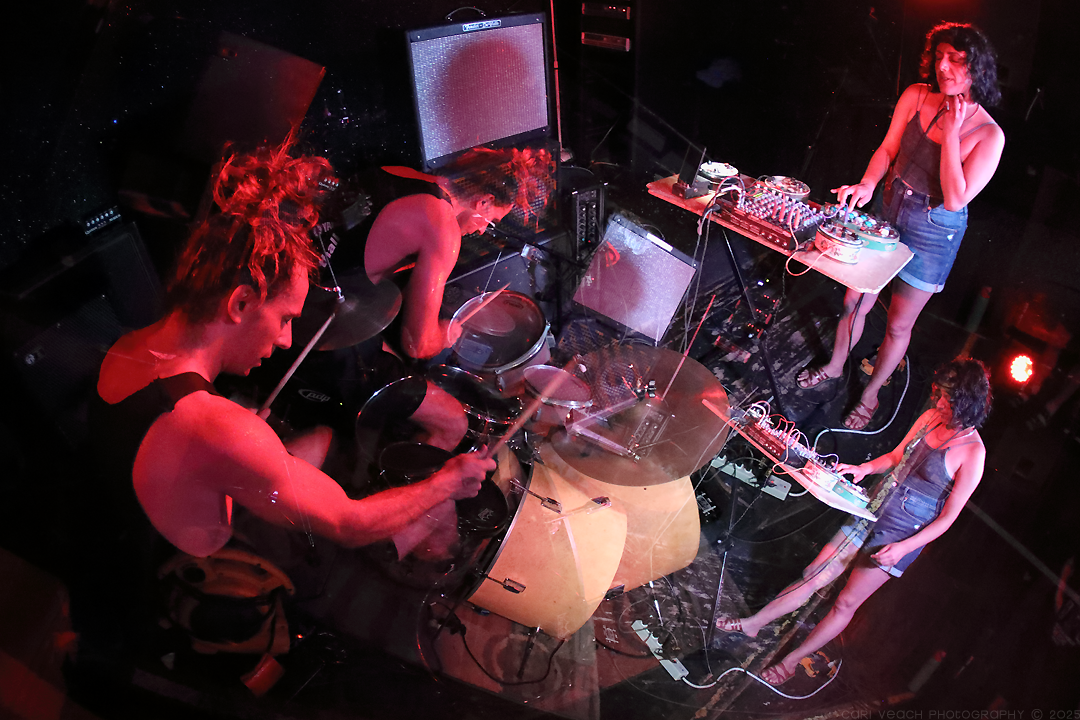
The first button I push produces a digital squeal that remains constant in pitch and volume. But when I twist a nearby knob, the electronic signal producing the noise gets interrupted. The further I turn the knob, the longer the interruption gets, until the squeal has turned into a staccato rhythm. Next I move to a slightly larger device that features two rows of green and white buttons that were made for arcade games. Each button lights up when I press it and creates a different distorted note on a musical scale.
It’s a lot of fun, but it’s hard to get lost in the primal art of making a racket while standing nearby and watching my every move is Noa Ver and Zach D’Agostino, the two musicians that make up the brilliant noise-rock duo Sea Moss. On a recent steamy evening in early June, they’ve allowed me to visit their practice space in North Portland to get a crash course in how they make the amazing sounds that they make.
They’re sweet and encouraging—”You might teach us something we don’t know!” D’Agostino enthuses at one point— but my self-consciousness kicks in at every step. Even when Ver hands me the contact microphone that she sets against her throat as she sings, creating distorted melodies and chants with her voice, I worry I’m going to find some way to break something right before the pair head out on tour.
I needn’t worry. Ver and D’Agostino don’t seem particularly precious about their gear and are eager to show me everything.
“If you have patience and like a pair of ears, then you can totally build one,” Ver says of her array of homemade electronic instruments. “We don’t gatekeep anything. There’s no secrets. If you have the patience to build one, then you deserve to have one. It’s not a proprietary thing. I have no intention of selling them or mass producing them or keeping any part of how they sound a secret.”
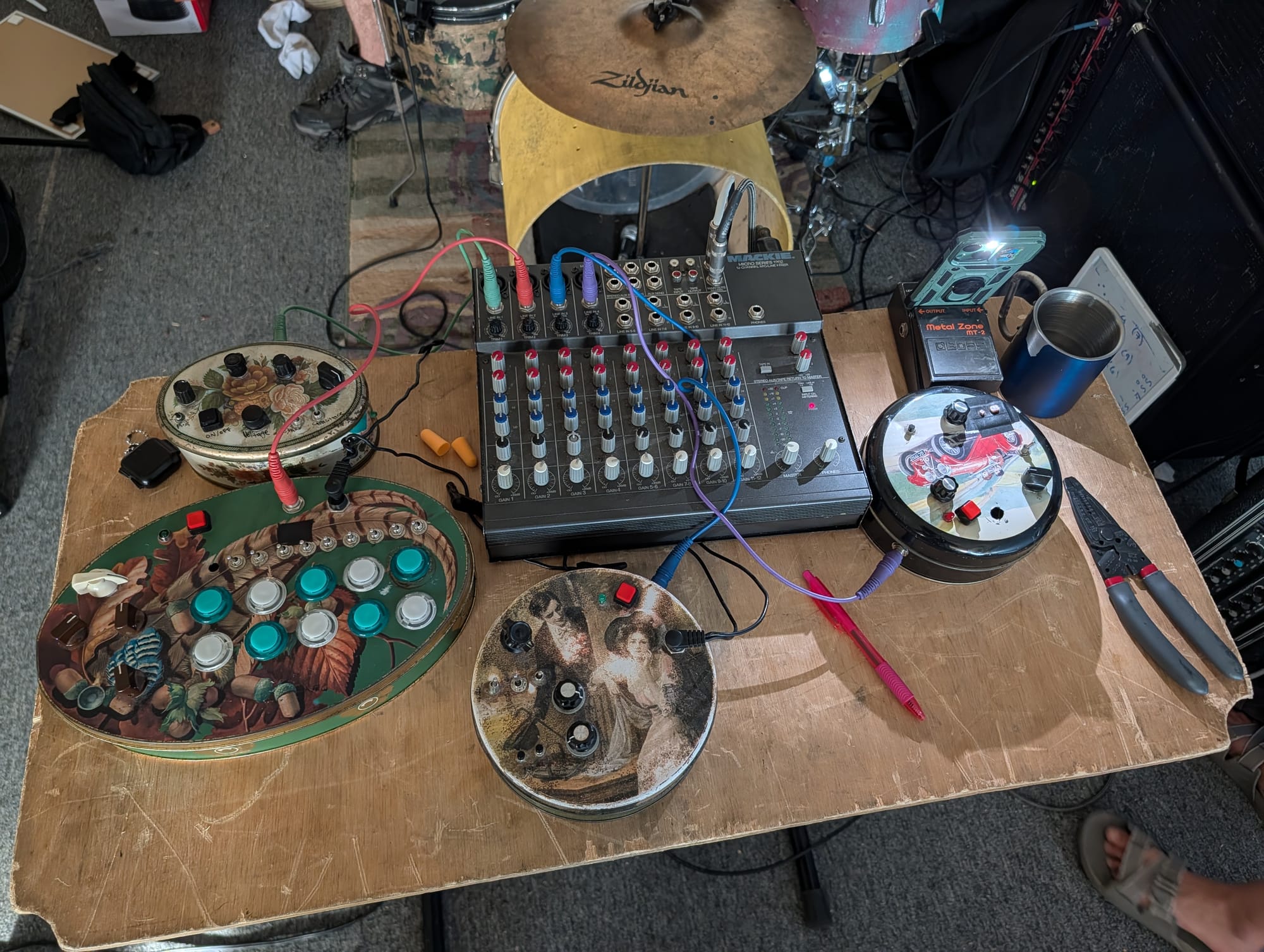
The bulk of Ver’s rig is built into tins found at thrift stores—the kind that once held face powder or tea cookies. The knobs, switches, and buttons were punched into the lids, and inside each is a nest of wires attached to a small circuit board and a 9-volt battery to power it all. One tin even has a pair of light-sensitive resistors soldered to the lid, which Ver triggers using the flashlight on her smartphone. It’s all designed to make a racket and take some abuse. If anything goes wrong, even during a live performance, Ver has a wire crimper nearby to do repairs on the fly.
D’Agostino’s gear is even sturdier. His trap kit is bare bones: snare, rack tom, floor tom, kick drum, hi-hat, and one cymbal. D’Agostino’s secret weapon is a former cash box whose lid is now festooned with switches. Each one affects the sound of the contact mics he has attached to his drums. As he demonstrates, whenever he taps on the kick drum pedal with his right foot, each hit of the batter produces not only the typical thump, but also a different synthetic sound. During my visit, the noise is something like a digital firework: a quick explosion followed by a long decay.
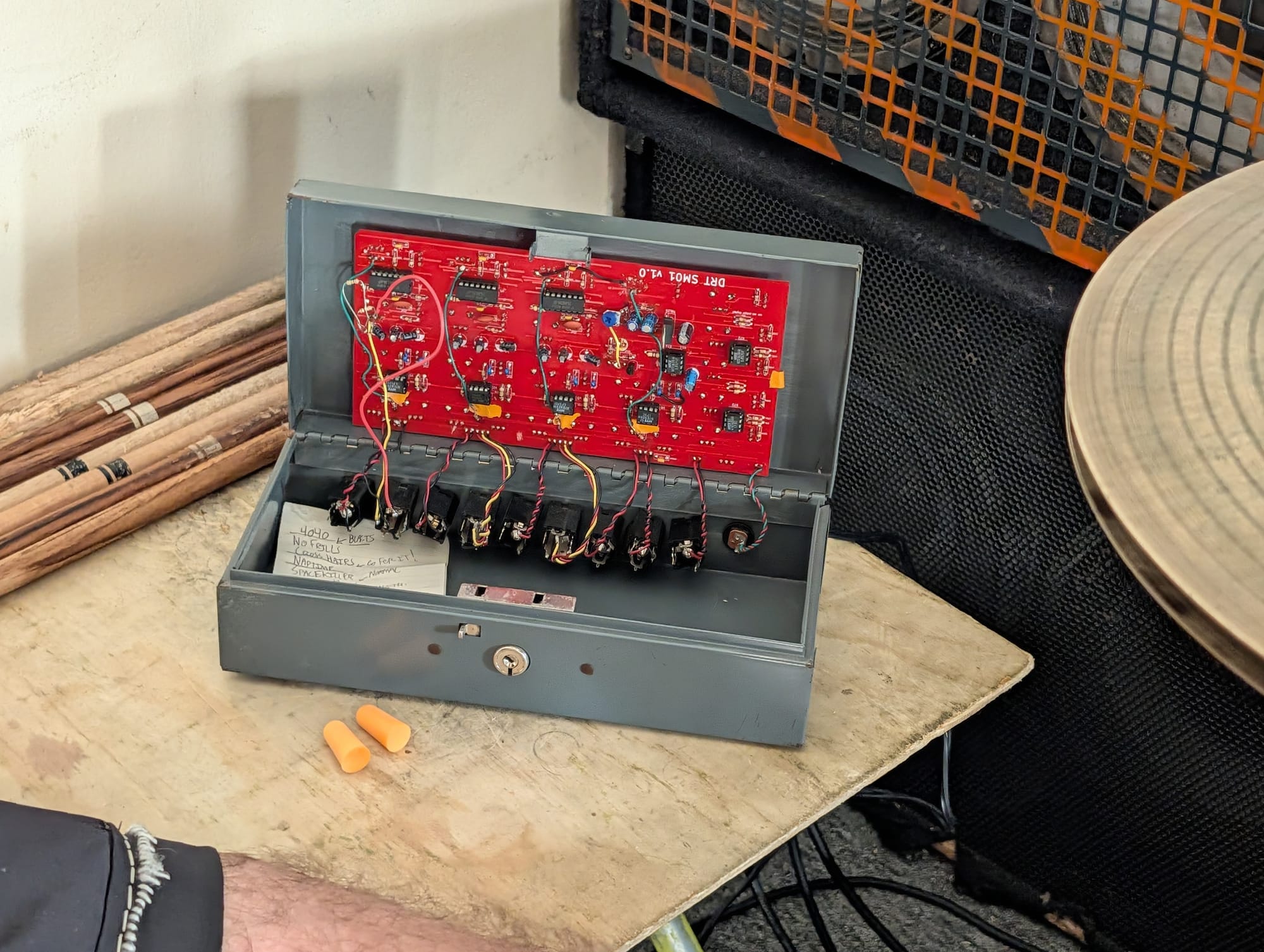
The other drums each have their own channel on the box, so each one can produce wildly different sounds if he chooses. The sonic possibilities that the two have at their disposal are seemingly infinite, which on paper sounds fun, but as they found out once they started making music together in 2017. At the time, both were on their own trip with Ver playing harsh noise and D’Agostino combining soundscapes and drums. (“It was like Philip Glass with blastbeats,” he says.) The two musicians were set to play solo sets at the same gig, but when the night became overbooked, they decided to improv as a duo to free up space on the bill.
“I was down, but I was also kind of suspicious,” Ver says. “When I moved here, I was doing [monthly electronic showcase] Volt Divers, and you would get paired up with people to do an improvised set. The frustrating thing about it was that it seldom felt like a collaboration. It felt like they had their big modular rig and they’re going to do what they’re gonna do, and I’m adding little bells and whistles on top of it.”
In comparison, Sea Moss feels like more of a musical conversation. Though they started out performing in a completely improvised mode, they soon started writing songs and developing a signature sound that seems to tumble ever forward, growing in size and strength like a sandstorm or a weather system. While one can hear the influence of fellow noise-punks like Lightning Bolt or Melt-Banana, there’s a thrilling uniqueness to D’Agostino’s blistering drum patterns and Ver’s distorted vocalizing and electronic squelches as their individual parts lock together and veer far apart. The pair’s latest recorded work, a split LP with Seattle group Miscomings, is a whirlwind of energy and precision. Just as they do in a live setting, Sea Moss rarely offer a moment of calm or fresh air to breathe.
The music is so precise in fact that, beyond wanting to know the story behind the tools of their trade, I wanted to understand how they construct their material. I get a small glimpse into their collective mind through a small whiteboard leaning up against one of their amplifiers onto which is drawn what appears to be a rough schematic of a song.
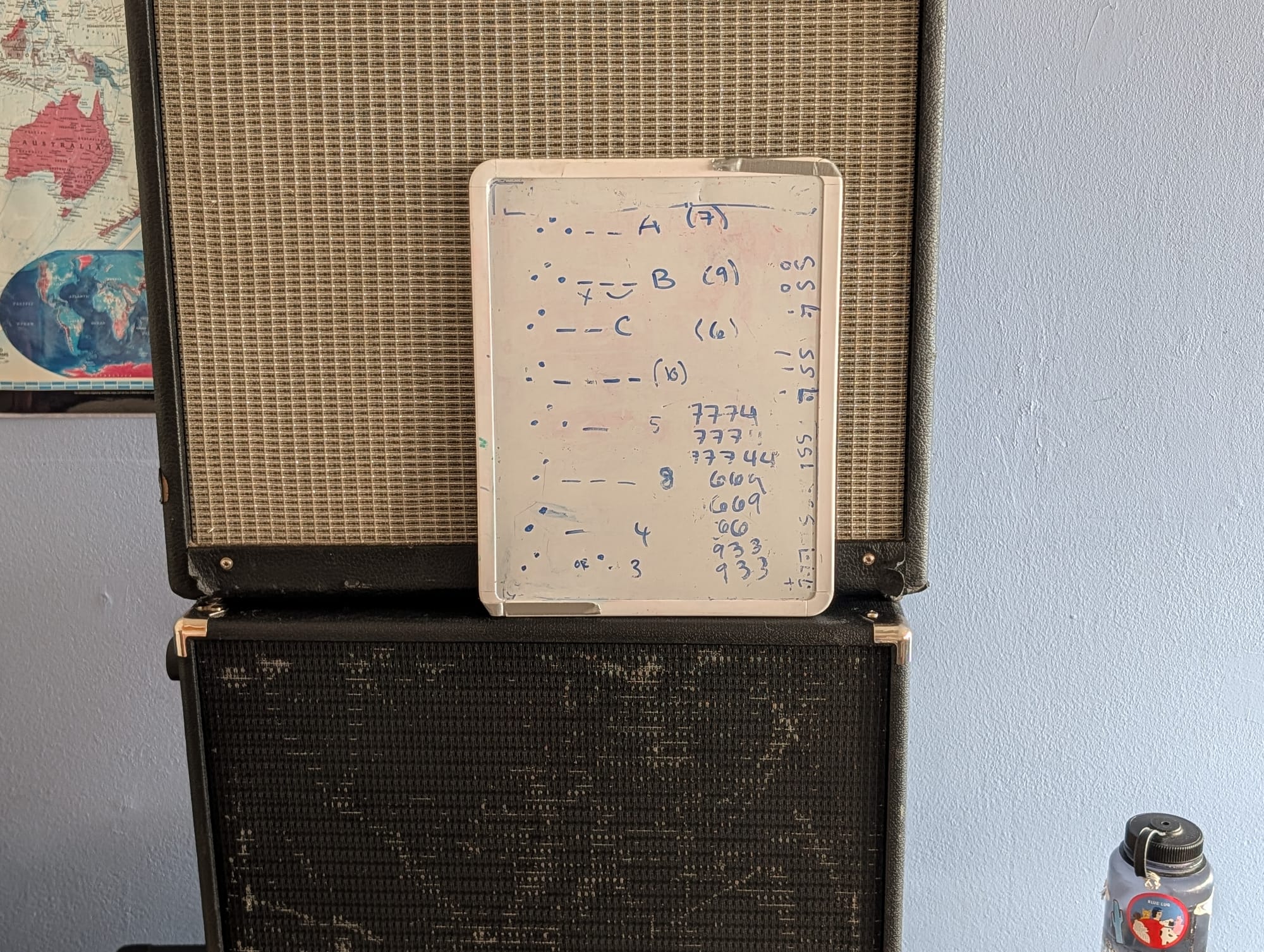
Having a blueprint like that on hand is the two nearing the finish line of getting a new song in their repertoire. The starting point is fairly typical: a good amount of improvisation and recording practice sessions on their phones. Some pieces immediately stick and get stitched into the larger tapestry; some get set aside until they eventually find a place for them. It's not nearly the elaborate compositional process I imagined, but it speaks to the shared motivations and spirit of Sea Moss.
“I think a lot of people, when they write music, have a thing that they want,” Ver says. “But what I want is to have the least amount of wants. I feel lucky that I get to work with someone who’s never frustrated at the fact that I can't do certain things or that is going to come in and be like. ‘I want a part that sounds like this, and I want you to do this.’ I might not be able. It might not be feasibly possible with my setup. That's never been a point of contention or frustration, and I appreciate that.”
I get a clearer sense of how the pair operate when D’Agostino invites me to bash on his drums. It's a surprisingly tiny kit put together with a mind toward practicality—all the drums fit neatly inside the kick drum—and I feel enormous sitting behind it. But I'm a lot more comfortable playing these than I am Ver's table of what she calls “critters.” I settle into my approximation of a Sea Moss beat. Both Ver and D’Agostino follow my rough lead, playing a nicely jagged melody punctuated by low drones and screeches. We had no goal in mind nor any desire to find one. There was just curiosity and fun and a whole lotta noise.
Sea Moss are performing at High Limit Room on Saturday July 11 with Miscomings, Spring Breeding, Obedient, and Happy Death Men
Artwork for this edition is by Vian Sora, whose exhibition Outerworlds is on display at the Asia Society Texas Center in Houston through August 2.